

.jpg)
Hi everyone, my name is Poorva and I graduated from Mac.Rob in 2024, scoring a raw 46 in English Language 3/4. In this article I will be going through the key metalanguage mistakes that prevent VCE English Langage ¾ students from scoring higher in their SACs at school and in the final exam.
As I’m sure you are aware, each piece of writing that you produce in Englang should be chock full of metalanguage. Metalanguage is literally the building blocks of your Short Answer Question responses, Analytical Commentaries and the Essay.
This is why even a student who can write really beautiful prose and analyses may still not score in the top band – if they don’t have a good grasp on the key ML from the VCAA Study Design to support their elaboration they will still lose marks.
However, metalanguage is not just about memorising technical terms. It is about using the right term, with the right example, in the right context.
Mistake #1:
The first mistake I would like to address is the fact that some students only name their feature (e.g. slang) without analysing what the feature does in context (e.g. reduces social distance and creates a relaxed, conversational tone).
Naming the feature is only the first step – this typically involves identifying the subsystem and if relevant, word class/subsystem process. I like to precede my actual quote with metalanguage (e.g. the syntactic listing of abstract nouns “think, feel, love” (26) enables …) in order to make things flow better.
However, that’s just the first step. Notice how I continued my sentence using the analytical verb “enable”? That’s the key part that some students miss. They need to go back, think about the initial stylistic effect and then link it to a sociolinguistic variable, such as register, audience, tenor, purpose, intent, function or context. This is dependent on what the SAQ is asking, or which body paragraph of your AC you’ve put it in, or what the overall prompt of your essay is.
With guidance from a VCE English Language tutor, you will learn how to build on the initial elaboration in order to create meaningful and robust links.
This is where targeted VCE English Language tutoring can make a real difference, because students receive feedback on how their metalanguage is actually functioning within the analysis, not just whether they have named a feature correctly.
.jpg)
Mistake #2:
The second mistake is not entirely about the metalanguage – but it’s about the fact that sometimes students choose weak or vague examples for their Section A and B responses, especially the Section B Analytical Commentary.
Their chosen quotes may be too long, and as a result the metalanguage chosen to identify the quote does not match the following analysis.
My favourite way of showing this in action is through the idea of mentioning a ‘declarative’.
Consider this excerpt from an AC.
The declarative “Our product has proven to lead to a 78% increase in patient recovery” shows the audience that M’s product is trustworthy since many patients have had success with it, ultimately aiding the brand’s intent of promoting their product as the market leader in clinical therapy.
While this analysis is not bad, there is definite room for improvement – especially in terms of specificity.
- Instead of quoting the declarative, which is too long anyway, use the metalanguage ‘ordinal number’ and ‘percentage’. That’s what we’re really focusing on, right? The declarative sentence type doesn’t convince the audience, but the high percentage success rate is what’s convincing. This will help you hone your analysis a bit more.
Mistake #3:
Alternatively, if you overload your AC with metalanguage, then rather than substantiate your analysis, it has more of a glossary effect. The marginal utility of each extra piece of ML you include is diminishing, and examiners/teachers won’t mark you higher just because you could identify the exact IPA of each letter in your quote (unless relevant, of course).
The key piece of metalanguage that precedes your quote should include 1. The most salient subsystem and 2. Be relevant to your upcoming analysis. Here’s a summary of the subsystems that are relevant to this VCE English Language Study Design.
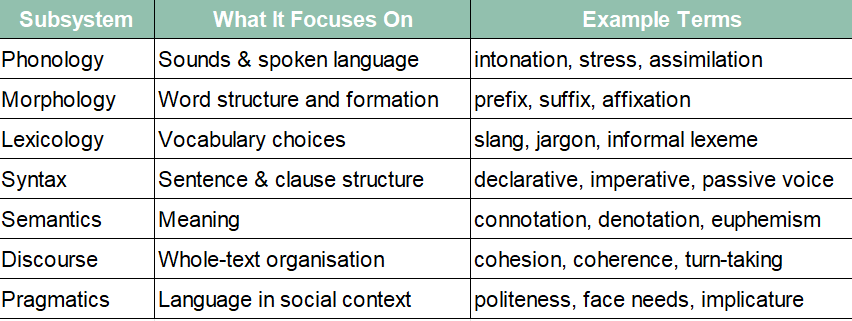
This helps you write a more text-specific analysis rather than a generic one that you could cut and paste into AC (a secret mistake #4).
How to fix your metalanguage analysis:
Ultimately, if you cannot explain why a feature matters in that specific text, it may not be the best feature to analyse.
Here’s a quick 5-step procedure that you can use to analyse a feature – starting from the ground up.
- Identify the feature accurately
- This involves knowing the correct subsystem and feature name, and also choosing a relevant, precise quote that isn’t too long
- Explain the stylistic effect
- This is the immediate impact that the feature has on the audience
- Link it to context, audience, purpose, function, register etc
- This is dependent on what you are ultimately trying to prove by including this example in your AC/Essay/SAQ to begin with
Having the careful instruction and guidance of a VCE English Language tutor can help you attain that next band up for your next SAC or allow you to achieve your dream Study Score.
If you are looking for an English Language tutor Melbourne students can rely on, it is worth choosing someone who can teach both the technical metalanguage and the exam strategy behind strong responses.
At Excel Education, the tutors work closely with the students to monitor the progression of their analyses, using once-a-term Module Assessments to quantify this growth and help students achieve their goals.
Final thoughts
Metalanguage is not about sounding complicated; it’s about showing the examiners your ability to sift through the text and find the most salient evidence and describing it with accuracy.
Need help improving your metalanguage analysis? At VCE Excel Education, our tutors help students turn metalanguage knowledge into stronger SAQ, Analytical Commentary and Essay responses.
Subscribe to our Newsletter
Learn more about our programs
Interested in more?
Take a read through our most recently published blogs.
.jpg)
.jpg)
.jpg)
.jpg)