

.jpg)
Hi everyone, my name is Poorva and I graduated from Mac.Rob in 2024, scoring a raw 46 in English Language 3/4. As we head into term 3 and start approaching exam season, I think it’s important to go through the key takeaways you can take from your studies this term to maximise your exam marks and optimise your preparation.
Earlier in the year, it may still feel like you’re building your foundations, learning new concepts and metalanguage, and getting used to the fast-paced nature of a Year 12 subject. By Term 3, you should have a clearer understanding of the skills and knowledge outlined in the vce english language study design. SACs still matter, but the final exam is now close enough that you need to start thinking differently about how each task supports your overall preparation.
However, time isn’t running out - it’s just that Term 3 is the moment where SAC preparation should begin to serve two purposes: performing well in internal assessments and building exam-ready skills for the final send in October.
Stop Treating SACs and the Final Exam as Separate Problems
You should no longer treat the exam as a distant problem. By Term 3, learning Unit 4 content and revising Unit 3 should be happening at the same time. Every SAC, practice response and piece of teacher feedback should also help you prepare for the vce english language exam, rather than being forgotten once the assessment is over.
Here are some ways you can integrate the two:
- Ensure that the contemporary media examples you are finding for your Unit 4 Essays will be useful for the final exam, and even after the SAC is over, do you best to practice reciting the analysis across the term.
- SAC feedback canr reveal repeated writing weaknesses. If you submit a few practice pieces and also get the same feedback on your SAC, it becomes very obvious what your writing weaknesses are. This avoids you having to circle around the problem. This is also where a VCE English Language ¾ tutor can be especially helpful, since you will be able to submit many pieces of writing to them and identify common patterns of mistakes.
- Preparing for SACs without thinking about exam transfer can waste useful revision time. If you aren’t writing under exam conditions (or close to it) by your Term 3 SAC, that’s valuable practice time that is not being optimised.
- Every SAC should leave you with something that will be helpful during revision time and SWOTVAC. This could be a number of things, such as how different sociolinguistic variables interrelate, or by you asking yourself “What did this SAC show me about my writing, timing, metalanguage, examples or analysis?”
.jpg)
What every practice writing piece and SAC should give you before you move on:
Some key takeaways include:
- Identify one repeated weakness - whether this be identification of examples/choice of contemporary media example, analysis, link, flow, metalanguage use etc
- Save useful examples for future essay writing. More importantly, make a note of excellent ELABORATIONS - try and use these key concepts, ideas and flow of writing in your final exam if possible, as the analysis of your example is arguable more important than the example itself.
- Note which metalanguage was used inaccurately - self explanatory
Some key actions:
- Rewrite one weak paragraph or answer, and get a teacher, tutor or even peer to check your writing. Ask them to compare it to your original answer so you can see directly how you’ve improved and integrated the feedback given to you.
- Turn teacher feedback into a checklist item
How SAQ, Analytical Commentary and Essay Practice Should Change in Term 3:
SAQs:
- Greater focus on the command word so you can optimise your response. Here is an example of the same questions answered very differently (despite them both being worth the same amount of marks) as the command word changes.
- Make sure you are writing the correct amount based on the mark allocation of the question. Always try and fill up all the lines provided to you - this may not be as important in the SAC since each teacher formats their paper in a different way, but it’s good practice for the final exam.
Analytical Commentary:
- Become more precise with the example you choose to analyse from the text. For example, not every declarative sentence is important, but maybe 1-2 key words from the sentence carries significant weight and are salient for you to analyse.
- Become more intentional with how you group your features together. Of course you should understand how to structure your AC, but even the order in which you choose to put your examples within the paragraph carries weight. You want it to flow - by connecting different examples together through their interrelated analyses, you show the teacher (and therefore the examiner) your understanding of all of the sociolinguistic variables and concepts learnt throughout the year.
Essay
- You should be using this time to improve your ability to adapt your contemporary examples to different types of essay questions. Of course the situational context and metalanguage will remain consistent across practice essays, but your link to the prompt and other concepts will depend on the key words in the essay question.
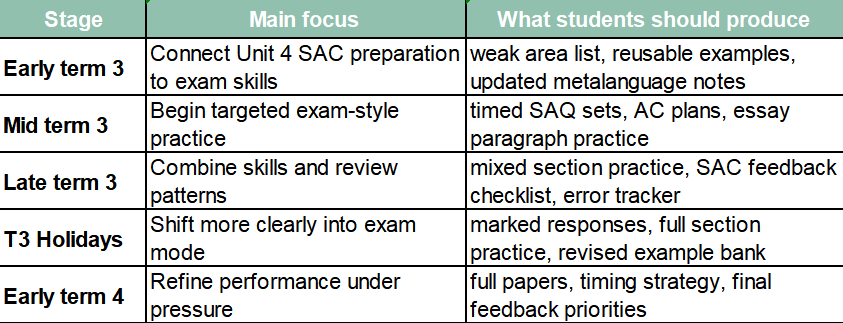
A Term 3 to Exam Readiness Timeline:
Common Term 3 Mistakes That Make Students Feel Busy but Not Ready:
Feeling busy is not the same as becoming exam-ready. Term 3 study needs to produce better answers, not just more notes. A student may spend hours reorganising notes and feel productive, but if they are not writing, receiving feedback and fixing repeated errors, their exam performance may not change much.
Try to make sure that you are:
- Producing tangible practice work that can be reviewed and improved, not just rewriting your notes
- Going back and reviewing your mistakes and why certain marks were lost, not just doing practice questions for the sake of getting them done
- Practising adapting your contemporary example analyses to the specific essay prompt, not just reciting the same paragraph over and over again
- Practising the hardest sections - so that you can improve - and not just what you are good at because it’s the most comfortable
- Confirming that your time management is under control well before trial exams, so that you don’t get a big scare in September
- Writing clear and specific analyses, not just word vomiting whatever sounds right.
How to Know If Your Term 3 Study Is Actually Working:
Here are some signs of effective study:
- metalanguage becomes more specific
- AC paragraphs have clearer functions
- essay topic sentences become less generic
- examples are easier to adapt to different prompts
- feedback starts repeating less often
- timing becomes more controlled
- you can explain why an answer earned or lost marks
Need help turning Term 3 SAC preparation into stronger exam performance?
At Excel Education, our VCE English Language tutors help students refine SAQ precision, Analytical Commentary structure, essay arguments and feedback application before the final exam.
Book a lesson or speak with our team to find out how targeted VCE English Language tutoring can help you make Term 3 count.
Subscribe to our Newsletter
Learn more about our programs
Interested in more?
Take a read through our most recently published blogs.
.jpg)
.jpg)
.jpg)
.jpg)