

Hi everyone, my name is Poorva and I graduated from Mac.Rob in 2024, scoring a raw 46 in English Language 3/4. As the final exam is coming up in about 2 weeks, this blog will focus primarily on what you can do to maximise your remaining study time and your potential marks.
If you’re feeling unprepared for the VCE English Language exam, start by finding out what is stopping you from turning what you know into a clear response.
Step 1: Determine your revision priority
Grab a previously attempted short text and one essay practice prompt.
Without using any notes, do the following
1. Minutes 1-4: find 2 good evidence pieces in the text, name the metalanguage and give a brief stylistic effect
2. Minutes 5-6: choose one of the above features and link it back to a sociolinguistic variable of your choice
3. Minutes 7-10: plan out your essay (including your contention, 3 chosen body paragraphs and any expert linguist quotes you can use)
The purpose of this exercise is to notice where you get stuck. You should consider repeating this 10 minute task a few times to identify a pattern – which section do I get stuck on the most?
Based on what happened, it’s easier to determine what your revision for the next 2 weeks should look like:
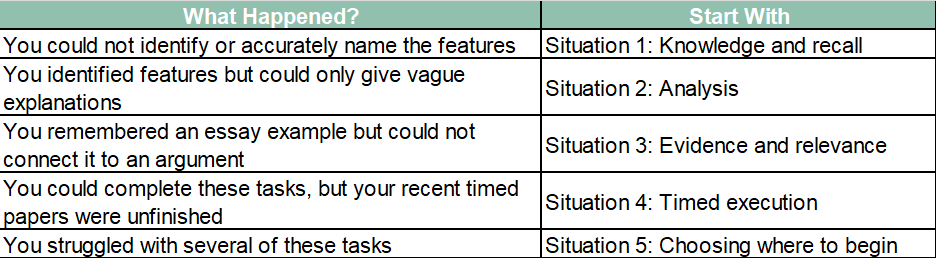
Use this result to give your English Language VCE revision a specific focus: “practise explaining evidence in context” is a more useful task for your next session than “revise everything”.
Situation 1: Knowledge and recall
What your revision could include:
- See what subsystem you struggle with the most by going through previous papers/SACs
- Making flashcards of the meaning of all of this metalanguage
- gradually broadening coverage rather than treating a small list as sufficient for the exam
When revising the metalanguage VCE English Language students are expected to know, test yourself in both directions: explain a term without your notes, then identify an example of it in a text.
Once identification is reasonably reliable, move to Situation 2 and practise explaining the feature’s contribution.
Situation 2: Analysis
This is mainly for students who receive this kind of feedback: “too general”, “explain further” or “link to context”.
Here’s how to improve
- considering what the communication is trying to achieve – put yourself in the shoes of the author or the reader/listener and think about how certain language choices would make you feel/make you do
- avoiding generic and boring claims such as “engages the audience”
- recognising that the same feature can function differently in different contexts
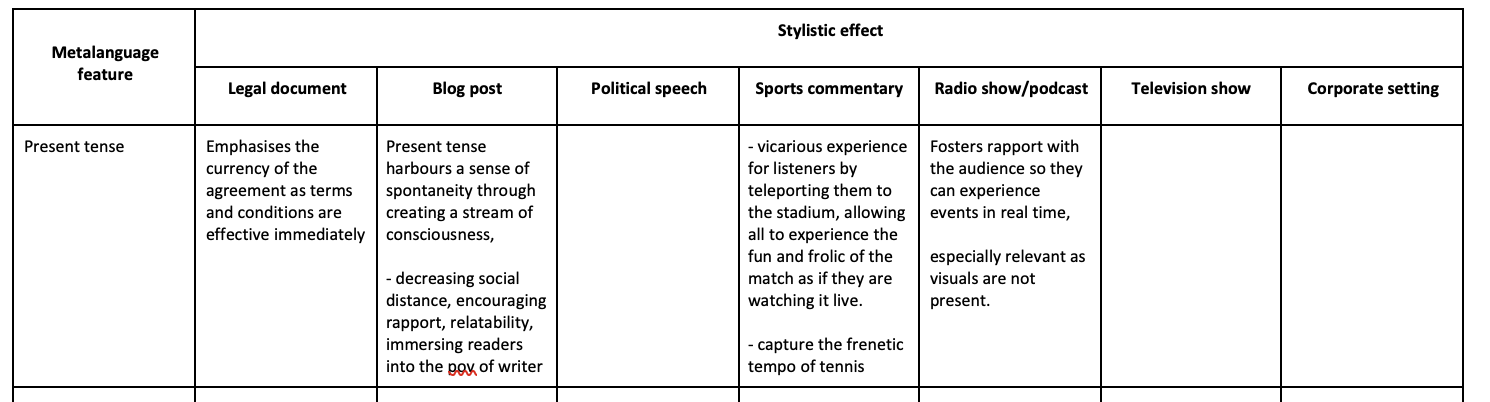
Ultimately, try to build a list of really common language features that you see the how the marking guide links it to register, tenor, function, purpose, intent, situational and cultural context etc.
Here’s what my glossary of stylistic effect looked like:
And here’s another doc I started preparing closer to exam time:
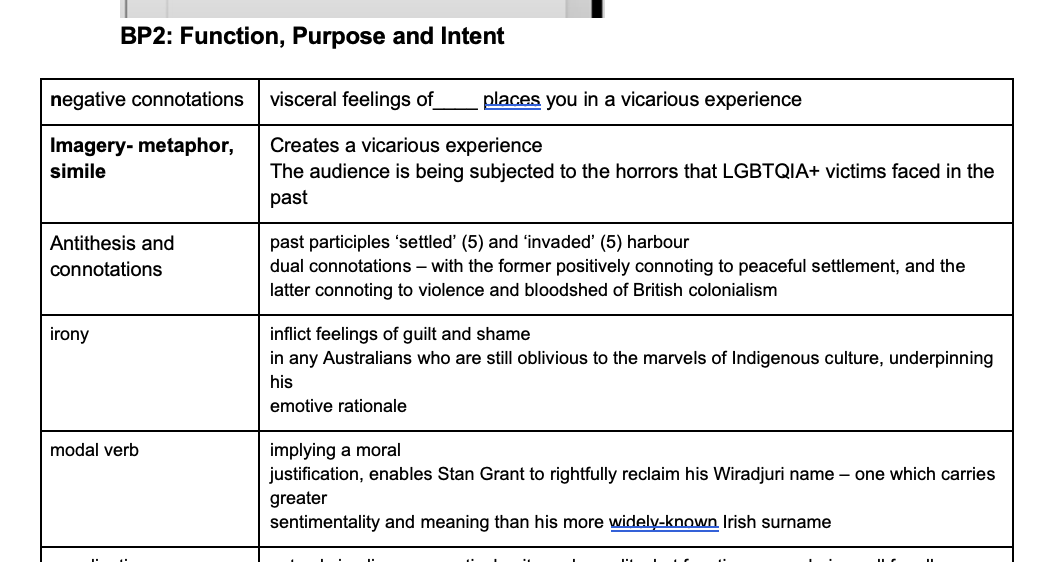
THIS SKILL IS WIDELY CONSIDERED TO BE THE MOST DIFFICULT AND WHERE THE MAJORITY OF STUDENTS TRIP UP. SPEND EXTRA TIME CONSOLIDATING YOUR IDEAS BY GOING BACK THROUGH YOUR AC WRITING.
Situation 3: Essay Evidence
If you remember the event but not the language evidence, create one concise evidence card containing the source, context, relevant wording, linguistic feature and a possible argument.
If you know the evidence but can’t connect it to the prompt, use one prepared example to consider two different prompts and see what is similar & different.
Situation 4: Time management
Find where time is being lost before deciding to write faster or complete more papers.
Do a practice exam section by section with the following time guides and record where the most significant delays occur:
- Short Answer questions – 20-25 mins
- Analytical commentary – 45-50 mins
- Essay – 50-55 mins
Consider the following:
- Slow evidence selection → practise selecting and justifying evidence.
- Retrieval pauses → practise closed-book recall.
- Repeated sentence editing → practise completing a short response before reviewing it.
- Excessive detail → review a completed paragraph and identify repetition.
Situation 5: more than one of these problems are relevant – where do I begin?
There’s a reason why these scenarios are in order.
Choose the earliest point where a response breaks down: Terminology -> analysis -> essay practice -> time management.
Choose one main priority for the next session.
Imagine you struggle with terminology, vague analysis and unfinished ACs. A practical starting sequence could be
- Accurately identify one feature.
- Explain it in context.
- Build a short analytical passage.
- Attempt a comparable passage under a time limit.
Final thoughts
You need a starting point, not a perfect revision plan, so you can avoid feeling overwhelmed.
An English Language tutor can help you work out whether an unfinished response comes from gaps in knowledge, difficulty explaining evidence or time management, so your next practice session targets the actual problem.
If you are unsure which problem to tackle first, bring a recent marked response to a discussion with Excel Education. Our tutors can help you identify your revision priorities and choose practical next steps before the English Language examination.
Subscribe to our Newsletter
Learn more about our programs
Interested in more?
Take a read through our most recently published blogs.