

.jpg)
Hi everyone, my name is Poorva and I graduated from Mac.Rob in 2024, scoring a raw 46 in English Language 3/4. This blog will focus on the upcoming exam and some of the most common problems students face on the actual day. For students preparing for English Language VCE, knowing how to recover when something goes wrong can be just as important as knowing the content itself.
Practice exams are usually completed under relatively controlled conditions, but the real exam may not play out exactly as expected.
Instead of just listing all the problems that could occur, I will walk through what you can do afterwards.
1. You realise that you misread an SAQ Halfway through your answer
Sometimes you misread the line number range given, or you misinterpret the command word, or you start linking you example back to the incorrect sociolinguistic variable.
What you can do:
- Identify which parts of the existing answer are still usable: oftentimes the example is fine and you just need to expand your elaboration or change the analytical focus to gain the analysis marks.
- Avoid the temptation to cross out an entire answer if only one part is incorrect
- Decide if correcting the response is no longer worth the extra time: you have more change of getting 2/2 or 3/3 marks for another question than trying to go back and get that 4th or 5th point for the last, long SAQ. be strategic about where to allocate your time because the VCE English Langugae exam is a speed run to the finish line.
- Similarly, I suggest you leave space in the text box and return later if the correction is becoming too time consuming.

2. You are struggling to find lots of strong features for the AC
Sometimes you get a text in front of you and think “crap, there’s nothing interesting to analyse”.
Instead of spending 10 minutes of writing time looking at the text and forcing yourself to find the singular 10/10 example, here’s what you can do instead:
- Focus more on the length and depth of your analysis to give the illusion that you have a strong understanding of the text - basically quality over quantity. Use fewer strong features rather than forcing weak observations into the commentary. Here’s an example of how your AC could differ depending on if your text is rich with features vs you are struggling to find strong examples:
Lots of features:

Lack of features (see how I’ve taken a very short quote and dragged on the explanation, but it still closely relates to the sociolinguistic variable I want to connect it to):
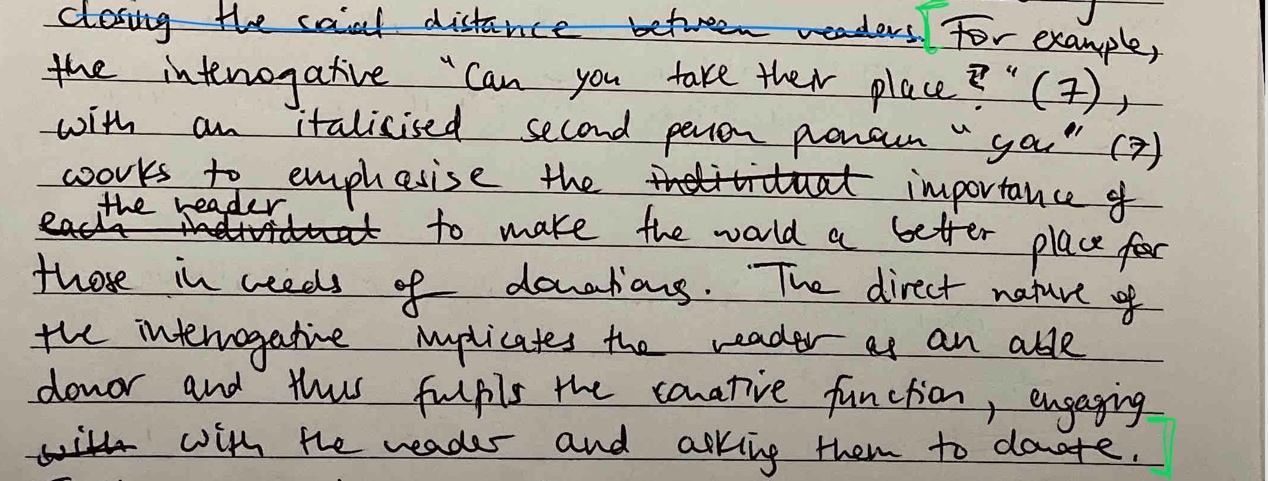
- Consider the less-used subsystems and how you could bring them into your AC as a last resort. Having a strong understanding of metalanguage in VCE English Language gives you more options when the obvious features are limited. For example, cohesion and coherence, phonetics and phonology, situational context and lexicology may not always be your first choices, but they can still provide useful material for a strong AC.
- Similarly, scan different subsystems rather than repeatedly looking in the same area.
3. None of the essay prompts work for your prepared examples
Now this actually happened to me for the 2024 exam. I thought then and there that it was wraps - I was not going to get more than a 25 in EL because my whole section C would be left blank.
Here’s what I did:
- Since none of the prompts immediately stood out to me, I started by using process of elimination. From there I was able to remove one the options because I knew that with the example bank I had prepared, I would not be able to write a complete and cohesive essay.
- Then I spent a minute or so drafting a sample plan for each of the remaining prompts and seeing which one I liked.
- Here is where my ability to adapt my examples to fit different types of prompts was really good.
Here is the prompt I ended up choosing from the 2024 end of year exam:

Despite this being one of the more unique prompts, I knew that I would be able to use some of my Unit 3 Area of Study 2 Formality examples here by including tenor. Understanding how concepts such as tenor, register, politeness and social standing fit within the VCE English Language Study Design made it much easier to adapt my examples to a less familiar prompt.
General
There we have it! I’ve covered a common problem that could occur for each of the 3 sections on the final exam.
Of course, there are plenty of other things that could go wrong, but it’s best to focus on your strengths and not get in your own head too much.
Students do not need every part of the VCE English Language Exam to go exactly as planned. They need to recognise problems early enough to protect the marks that remain available.
At VCE Excel Education, our VCE English Language tutors help students identify where marks are being lost in practice exams and develop more reliable strategies before the final VCAA exam.
Subscribe to our Newsletter
Learn more about our programs
Interested in more?
Take a read through our most recently published blogs.
.jpg)
.jpg)
.jpg)
.jpg)