

.jpg)
Hi everyone, my name is Poorva and I graduated from Mac.Rob in 2024, scoring a raw 46 in English Language 3/4. This blog will address a question that our lovely Year 9s and 10s will soon be asking — is VCE English or VCE English Language the right subject for me? Sure, they have similar names, but they could not be more different in content and execution.
Many students (and parents) assume that VCE English Language is simply a "harder version" of VCE English. In reality, they are completely different subjects — they test different skills, use different assessment formats, and suit very different types of students.
What Is VCE English? (The One That Majority of Students Choose)
Firstly, the core components of this VCE subject are literary analysis essays, creative or persuasive writing, and oral presentations.
In my experience, the type of students that are well suited to this subject exhibit these traits:
- Enjoys stories and texts (novels, films, etc.)
- Strong in expressing ideas
- Comfortable with interpretation and argument
It's important to note that VCE English does not require the memorisation of technical linguistic terminology — it relies more on reading comprehension and overall writing ability. The writing techniques build on what you start learning in Year 7, such as analytical writing and persuasive text analysis, although to a much higher standard and at a much faster pace. The core structure of what you write and how you write it is not a drastic change from what you are taught in Years 7–10.
In terms of scaling, since this is the most popular English subject, it has a large cohort which leads to incredibly high competition. On average, your scaled score is one lower than your raw score — however this is subject to change depending on the year, level of difficulty, cohort ability, and your own raw study score.
.jpg)
What Is VCE English Language — And How Is It Different from VCE English?
VCE English Language is less about novels and creative writing, and more about how the English language itself works. We look at things at a micro level first — analysing word classes and how things fit together to create a cohesive text — and then again at a macro level: what the overarching purposes of the author's texts are.
While studying VCE English Language for two years, students learn to: analyse real spoken and written texts using metalanguage, study how language changes across contexts (formal vs informal, dialects, digital communication), and explore the history of English (Old English to 21st Century English).
Students — make no mistake of underestimating Englang. This is a difficult subject. We learn two completely new structures of writing, called the Analytical Commentary (AC) and the Contemporary Essay — which are unique to VCE English Language. You also have to wrap your head around metalanguage (phonology, discourse, pragmatics, etc.) and not just memorise it, but truly understand it and integrate it naturally into your writing.
However, something that a VCE English Language tutor can help you with is teaching you the key concepts efficiently — so you can spend more of your time practising writing rather than going back and forth between the textbook and the internet trying to determine what is important.
In my experience, the type of students that are well suited to this subject exhibit these traits:
- Enjoy analysing how things work (grammar, structure, language use)
- Are curious about why people speak differently in different contexts
- Prefer analytical tasks over creative writing
- Are willing to invest time learning technical terminology
- Think in a structured, systematic way
Those who should think carefully before choosing this subject may find themselves as someone who:
- Prefers storytelling and creative expression
- Dislikes memorising terminology
A quick note about scaling — regardless of the raw score you get, your scaled score will typically scale up by 1–2 marks, since this is overall deemed to be a more difficult subject than VCE English. However, students shouldn't pick this subject just because it scales up — if you find yourself not enjoying it, your performance will suffer regardless.
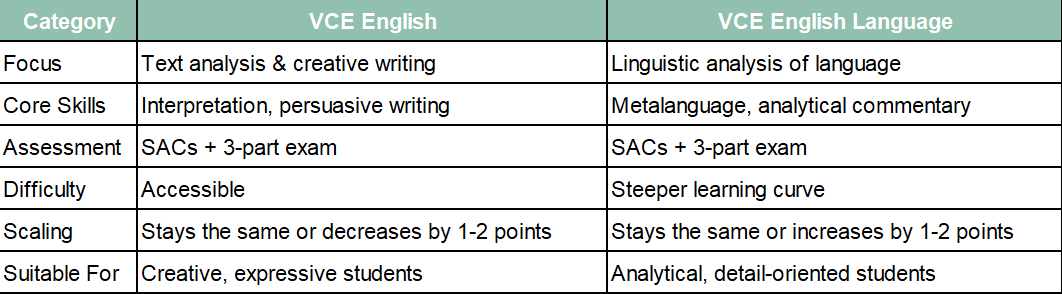
Side-by-Side Comparison
My Opinion
I believe that if a student is well-suited and thinks they can achieve Raw 40+, doing VCE English Language is highly beneficial. If they are worried about the workload and being exposed to completely new content, VCE English may be the safer option.
I personally have no regrets about choosing VCE English Language, because I knew I wasn't a naturally eloquent writer to begin with — but Englang focuses a little less on HOW and more on WHAT you are writing. I valued the structure and analytical lens that it put on English, and I find myself using some of the concepts I learnt in my everyday life, since it is much more applicable to the real world in comparison to VCE English.
Also, the VCE Englang exam is only two hours while the English one is three :))
What Can a VCE English Language Tutor Help You Achieve?
So we have established that VCE English Language is objectively harder — due to the technical metalanguage that is unfamiliar and new to all students, and the new writing structures that must be learnt from scratch.
Most students struggle in the first few weeks of English Language because of this. But top students are not those who find it easy early on — they are those who build strong foundations, get structured support early, and avoid relying on "gut feeling". Working with a vce english language tutor early, rather than waiting until problems arise, is one of the most consistent patterns among students who go on to achieve Raw 40+. For students based in Melbourne, finding an english language tutor melbourne students and families trust — one who understands the VCAA study design inside out — can make a significant difference from as early as Term 1.
For those interested in getting tutoring early on, I highly recommend reading what a vce english language tutor actually helps with — this provides key insight into why getting a tutor may drastically improve your score and the overall experience you have with the subject.
If you are considering VCE English Language and want a clear, honest understanding of what it takes to score Raw 40+, our team at Excel Education has guided over 750 students through this exact decision.
Reach out for a free consultation! We will tell you honestly whether it is the right fit, and if it is, how to set yourself up for success from Day 1 with Melbourne's most trusted english language tutor program.
Subscribe to our Newsletter
Learn more about our programs
Interested in more?
Take a read through our most recently published blogs.
.jpg)
.jpg)
.jpg)
.jpg)