

.jpg)
Hi everyone, my name is Poorva and I graduated from Mac.Rob in 2024, scoring a raw 46 in English Language 3/4. This blog will address the number one reason why VCE English Language students are not scoring as highly as they would like on their Analytical Commentaries.
Picture this: A student uses accurate metalanguage in their Analytical Commentary and demonstrates a clear understanding of subsystems, yet their final score falls short of expectations. The feedback often mentions: “lacks contextual awareness.”
Sound familiar? This situation is very common in VCE English Language and points to a critical issue: context is not an optional add-on in analysis. It is a fundamental dimension that shapes language choices and their interpretation. This is also one of the reasons many students look for VCE English Language tutoring when they realise that knowing the terminology is not the same as knowing how to build a high-scoring analysis.
What does “context” actually mean in VCE English Language?
Most students think it means background or setting. But I believe that context can be broken down into 3 layers in this subject.
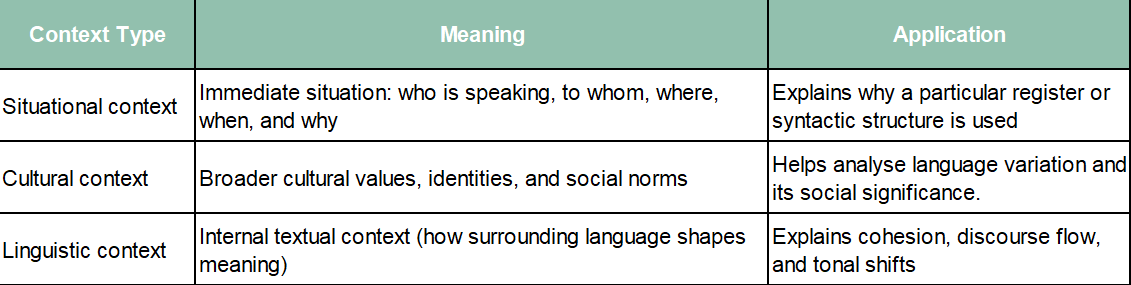
Remember, examiners aren’t looking for descriptions of the context - they are looking for how context explains language choices.
Ask yourself: How does this specific context make this language feature meaningful or necessary?
How to apply “context” in Section B (and more) :
Always asl yourself the following questions during reading time/at the beginning of writing time:
- Who is the speaker/writer, and who is the audience?
- What is the purpose of the communication?
- What social dynamics or power relationships are present?
- What is the mode (spoken, written, digital)?
Remember, these answers should be woven into every sentence of your AC, not jut mentioned sparingly once or twice.
Here is a brief outline of how context is used in every part of the exam:
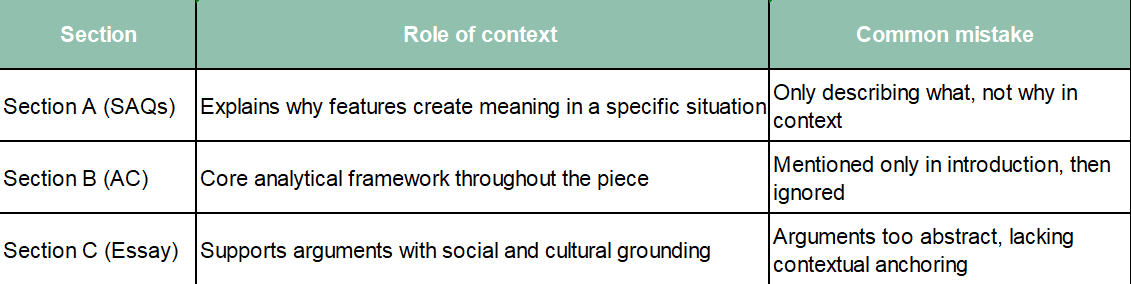
What do Raw 40+ Students do differently?
Top students do not treat AC as a feature-identification task.
Instead, they reconstruct the full communicative context and use context to drive every analytical decision. A good English language tutor will often train students to move beyond simply naming features and instead explain why those features matter in that exact text, audience, purpose and social setting.
Here is a weak example:
The author uses the declarative sentence “Here are some of the … this year” (8) to fulfill a formal register since he is providing information through his email.
· Not text specific & context specific
· Poor use of metalanguage.
Here is a strong example:
However, the register shifts in the main body of the email, adopting a more formal register through Young’s use of formulaic elements that adhere to the expectations and norms of a more formal email, such as through the declarative sentence “Here are some of the … this year” (8).
· Strong connections to cultural context eg in terms of the beliefs that Young holds in conforming to norms and expectations
To transform your writing and score better in this subject, consider getting a VCE English Language tutor. I highly recommend you read something else I wrote earlier this year, called What does a VCE English Language Tutor actually help with?. This provides key insight into why getting a tutor may drastically improve your score and the overall experience you have with the subject.
.jpg)
So what’s next?
If you are the kind of student that begins writing their AC by identifying key features first, try considering the context instead and let that guide your writing. If your context analysis feels vague, focus on why your analysis lacks depth. And finally, even though Year 12s are already a third of the way through the year, it is not too late to switch up your writing style.
Consistency is key!
If you are considering VCE English Language and want a clear, honest understanding of what it takes to score Raw 40+, our team at Excel Education has guided over 750 students through this exact decision.
For students looking for an English language tutor Melbourne families can trust, the right support should help you understand not just what to write, but how to think through context, purpose and language choices under exam conditions.
Reach out to Excel Education for a free consultation! We’ll review your writing and show you exactly where your context analysis is working, and help you set yourself up for success from Day 1.
Subscribe to our Newsletter
Learn more about our programs
Interested in more?
Take a read through our most recently published blogs.
.jpg)
.jpg)
.jpg)
.jpg)