


This guide is designed for VCE English language students preparing for informal language analysis across SAQs, ACs and essays. At Excel Education, we teach a repeatable method that helps you move from feature-spotting to high-scoring social meaning. If you’re working with a VCE English language tutor, use the checkpoints below to turn your draft into something exam-ready without overloading metalanguage.
Short Answer Questions (SAQs)
What SAC and exam markers usually reward in SAQs is precision, tight evidence, and clear effect. The most common issue is listing features without explaining how they position the audience, so every feature you identify should lead to a social meaning rather than a description.
How to structure an SAQ?
Contextual Factors:
Audience, Purpose, Tenor, Function, Register, Situational and Cultural Context.
1. POINT - Identify the Feature
This is where you:
· POINT OUT the language feature using metalanguage
The writer employs [metalanguage feature]…...
2. QUOTE - Provide Evidence
· Use a short, embedded quote
· Only include the necessary words
· No full sentences unless needed
3. COMMENT - what is the stylistic effect?
Consider:
· Why did the author choose this metalanguage?
· How does it affect/position the audience?
4. LINK
· Link to the wider social aspect of the question - i.e: contextual factors
One-sentence SAQ model:
The writer employs [feature] to [effect], positioning the audience to [response], reflecting [context/tenor/purpose]. Keep the quote short and ensure the explanation is longer than the evidence.
SAQ Function bank
How to choose the best feature:
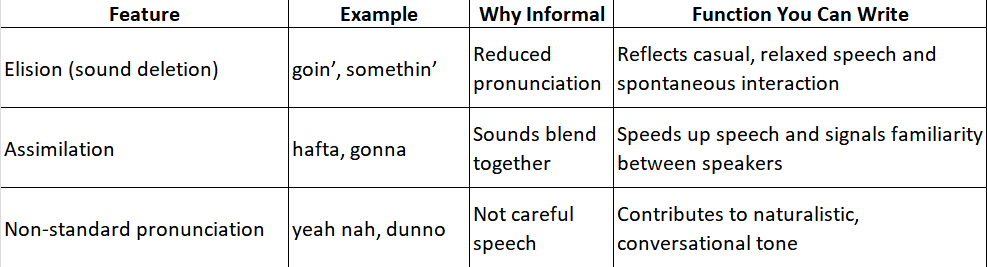
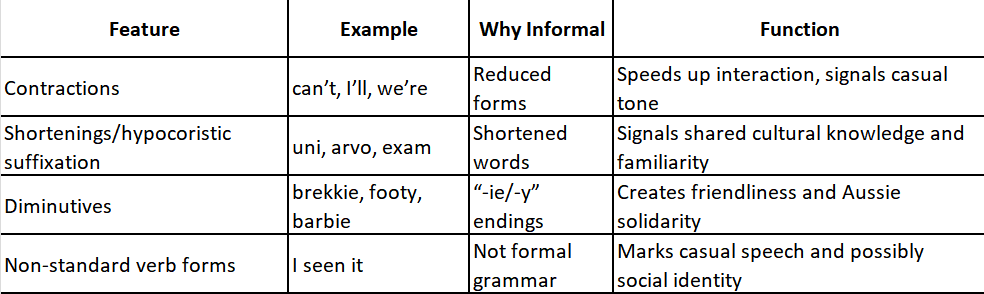
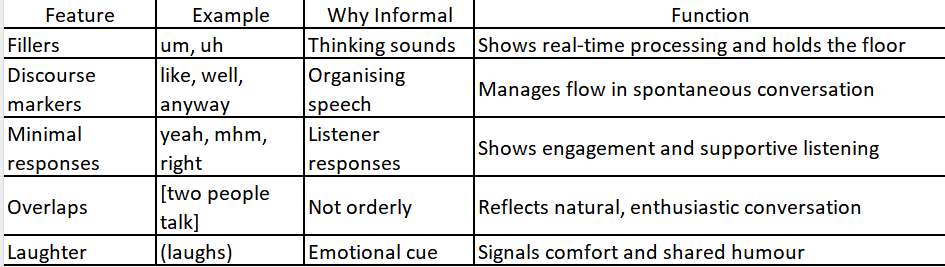
Select the feature that most clearly connects to a contextual factor such as audience, purpose or tenor. If two features perform the same role, choose the one that allows the strongest social explanation such as identity, stance, power or solidarity.
1.Phonology
2.morphology
3.Pragmatics

4.Lexicology

5.Syntax

6.Discourse Features
Potential sentences for stylistic effect (need to be expanded further in SAQ answer):
- “This reflects the spontaneous nature of spoken interaction.”
- “This contributes to a relaxed and informal tone.”
- “This signals familiarity and social closeness between participants.”
- “This relies on shared contextual knowledge.”
- “This supports the collaborative nature of informal conversation.”
Expanded examples you can adapt:
- This reflects the spontaneous nature of spoken interaction by mimicking real-time processing, making the exchange feel authentic to the audience.
- This contributes to a relaxed and informal tone through lowered formality and interpersonal warmth rather than authority.
- This signals familiarity and social closeness by reducing social distance and positioning participants as insiders.
Analytical Commentaries (ACs)
In VCE English language, strong ACs do not read like a checklist but a social interpretation supported by metalanguage. Begin with a clear social focus such as solidarity, identity or stance, then support it with clustered features and precise evidence.
For informal texts, paragraphs often focus on things like:
- Relationship building (solidarity)
- Spontaneity & spoken features
- Identity construction
- Managing conversation flow
- Tone (playful, supportive, emotional, etc.)
Each paragraph needs a clear social focus, not just a list of features.
How Many Body Paragraphs?
There is no fixed number.
You could write:
- 3 long paragraphs
- 4-6 shorter paragraphs
What matters most is:
- Each paragraph has a clear focus
- The first sentence signposts what the paragraph is about
Choosing a Structure
Most students use a thematic structure (based on things like):
- Register
- Audience
- Tenor
- Context
- Social Purpose
- Functions (phatic, referential, etc.)
Be careful with a separate “discourse features” paragraph (cohesion/coherence, spoken features).
This can:
- Make your AC feel split or unfocused
- Cause you to forget context or tenor
- Lead to generalised analysis with no specific evidence
Instead:
Weave discourse features into other paragraphs, just like you would with subsystems.
High-scoring topic sentence stems:
- Through an informal tenor, the text constructs solidarity by…
- The interaction positions the audience as insiders by…
- Spoken discourse management supports…
- These choices align with the purpose within the cultural context of…
HOW TO BUILD THE PARAGRAPH
You should move through multiple features in one paragraph, linking them together.
For EACH feature, you must:
Identify — Name the feature using metalanguage
Exemplify — Give a quote + line number
Explain — What meaning/effect does it create?
Link — How does this support:
- purpose?
- Register?
- Context?
- Audience?
- Tenor?
30-second self-check before submitting:
- Did I name the subsystem correctly?
- Did I explain the social meaning rather than the feature itself?
- Did I link to audience, purpose or tenor?
- Did I avoid repeating the same function explanation?
Step 1 - Read the Whole Text First
Before hunting for metalanguage:
- Read the background info
- Think about it holistically
Step 2: Choose a Paragraph Focus
Decide what each paragraph will be about.
Example paragraph focuses:
- Register, audience & tenor
- Context & function
- Purpose & intention
Step 3: Find SECTIONS, Not Features
Don’t scan for random techniques.
Instead, find parts of the text that match your paragraph focus.
Example (Register/Audience/Tenor focus):
- Imperatives → persuasive register
- Youth slang → teen audience
- Friendly visuals → informal tenor
Step 4: Ask Meaning Questions
For each section you pick, ask:
- What does this section mean?
- Why does it match my paragraph focus?
- Could it link to another factor too?
- What is the best overall interpretation?
This helps move from feature spotting → analysis.
Step 5 - Add Metalanguage to Support Your Idea
Now you can identify the actual language features.
Essay skills
Purpose of an ENL Essay
At its core, an English Language essay functions as a social commentary on how language is used in contemporary Australian society. Students are required to analyse language choices using metalanguage, link these choices to sociolinguistic concepts, and maintain a clear connection to the essay prompt.
What Examiners Look For
Essays should demonstrate a clear contention, consistent reference to the prompt, and a complex understanding of language use. Each body paragraph should generally include two contemporary Australian examples supported by relevant subsystem metalanguage. Evidence should also be linked to broader social meanings and identities.
Essay Structure
Essays typically follow this structure: Point, Quote, Contextual comment, and Larger social link. This structure ensures that evidence is clearly integrated and analysed rather than described.
Breaking Down Prompts
Students should identify key terms, modal verbs, and command words in prompts. Understanding whether a prompt asks you to 'discuss' or evaluate 'to what extent' is essential in shaping a nuanced contention.
Contentions
A contention is the writer’s overall position in response to the prompt. Strong contentions are specific, nuanced, and capable of being developed across at least three arguments.
Topic Sentences
Topic sentences frame each paragraph and should clearly link back to the contention. Advanced topic sentences create a through-line by extending, challenging, or refining earlier arguments.
Introductions
Introductions should clearly state the contention and signpost the main arguments. They may begin with a brief contextual statement but must remain concise and analytical.
Body Paragraphs
Body paragraphs should include a topic sentence, two pieces of contemporary or stimulus-based evidence, analysis using metalanguage, and links to sociolinguistic concepts. At least two paragraphs should integrate expert linguist perspectives.
Evidence Types
Evidence may include contemporary Australian examples, SAC stimulus material, and expert linguistic commentary. All evidence must be relevant, recent, and meaningfully analysed.
Conclusions
Conclusions should complete the argument loop by reaffirming the contention and synthesising key ideas. No new evidence or concepts should be introduced.
Improving Writing Skills
Regular writing practice, critical self-editing, and wide reading help strengthen analytical writing skills. Students should aim to consistently reflect on how language constructs meaning in context.
For Informal essays:
- Contemporary evidence should be rooted in certain varieties of IFL, such as Australian slang, teenage slang, Profanity, etc…
- Many topics will revolve around certain attitudes to informal language
How to Introduce Evidence Properly
You must include:
User Context
Who are they?
- Public figure? Influencer? Politician? Brand?
Situational Context
Where was the language used?
- TV show?
- Social media?
- Advertisement in public?
This helps you discuss:
Expectations, Audience, Appropriateness
If you are revising for SACs or exams, bring one paragraph draft to a VCE English language tutor and ask two questions: what is my social focus, and which evidence best proves it. Excel Education uses this approach to help students build consistent high-scoring analysis without memorising feature lists.
Subscribe to our Newsletter
Learn more about our programs
Interested in more?
Take a read through our most recently published blogs.
.jpg)
.jpg)
.jpg)
.jpg)