


Hi everyone, my name is Poorva and I graduated from Mac.Rob in 2024, scoring a raw 46 in English Language 3/4. Like many students preparing for VCE English Language, I benefited from targeted guidance and structured feedback similar to what you would receive from a dedicated VCE English Language Tutor. We will be kicking off 2026 by taking you on aguided tour of metalanguage across units 1-4 VCE English Language, and how youcan wield it to achieve maximum marks on your internal and external assessments.
First, let’s understand what metalanguage is. They are all the technical terms mentioned inthe Study Design that you build your Short Answer Questions, Analytical Commentaries and Essays around. Essentially, consider them as the buildingblocks of the subject. Without a strong grasp of metalanguage, it becomes extremely difficult to score highly in the VCE English language exam, where precision and consistency are heavily rewarded. The reason why Englang is dubbed as the “science” of the VCE Englishes is because there is a lot of metalanguage to learn and it is very analytical.
Metalgnuage canbe broadly split up into 6 subsystems, as per the most recent VCE English Language Study Design that was released in 2024. I will go through the top 2-3features from these subsystems and the best way to utilise them in order tomaximise your marks.
Phonetics and phonology
- Connected speech processes - these include elision, vowel reduction, insertion and assimilation (EVIA). These are helpful in making a comment about the national or ethnic identity of the speaker. Typically with a broad Australian accent, there is a tendency to to cut off the last cononsant in some words - a testament to our lazy speech. Eg with the verb “coming”, we use assimilation on the consonant “g” (/cʌmɪɧ/ → /cʌmən/)
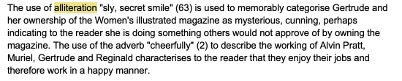
- Phonological Patterning - alliteration, assonance, consonance, rhyme and rhythm, onomatopoeia. These are used to make a point more memborable through these playful nature, and at times can reduce the social distance between the user and their audiences.
Morphology
- Affixation - prefix, suffix, infix (either inflectional or derivational). The use of infixes to create a new non-Standard word indicate the author’s playful personality (eg abso-freaking-lutely) and the closer tenor between the author and the audience through the more relaxed language use.
- Word formation processes - Compounding, blending, commonisation, conversion, acronyms, initialisms, reduplication, borrowing.
Lexicology
- Verbs - I want to specifically discuss dynamic verbs here eg running and jumping as opposed to stative verbs eg think and listen.
- Pronouns - first/second/third person, possessive, plural/singular, object/subject.
- Let’s discuss these two features in tandem. Take the following simple sentence “I will personally chase this up now.” from the 2024 Sample Exam Analytical Commentary, found on the VCAA English Language website. Here are the notes I wrote when I first read the text.

Syntax
- Sentencestructure - simple, compound, complex, compound-complex sentences and sentencefragments. You will first come across these in Unit 1 Area of Study 2 ChildLanguage Acquisition. As children get older, we develop the ability to uselonger and longer sentences as well as use conjunctions to move specific ideasto the foreground or background depending on how important they are. An exampleanalysis:
- Phrasesand clauses - eg noun phrases/verb phrases/main clauses/independent clauses.These would be my go-to metalanguage to describe quotes if I’m not sure of anyother way to describe it using ML. They are quite neutral - and especiallyhelpful in packing some metalanguage when describing a quote for a contemporaryexample in Section C Essay. For example:

Semantics
- Semanticrelations - synonymy, antonymy, hyponomy/hypernymy, metonymy. Semantic relations are one of my favourite types of metalanguage; This is also an area where many students see rapid improvement when working closely with a VCE English language tutor, as semantic analysis often separates mid-range responses from top-band ones. each time you use ityour analysis of the text is always so rich and has depth, unlike with some ofthe other subsystems (looking at you phonology). Here is something that mytutor Harley guided us to find in the 2018 VCAA AC text… after all this was hisexam that he scored 15/15 for!

- Connotations- this is my absolute favourite. Positive and negative connotations, elevation,deterioration, shift, euphemisms and dysphemisms etc. These are so versatile -I use them for almost all SAQs, ACs and Essays. I find that you can link themto:
- Purpose eg by using positive connotations a company can obfuscate the true nature of their product or services
- Values eg cultural or social connotations of a certain slang word in Australia can show how we are part of an Aussie in group
- Intent eg connotations shifting focus away from something
- Identity eg by using euphemisms a politician can hide their true identity and try to gain votes
Discourse and pragmatics
- Spoken discourse features - closings and openings, overlapping speech, minimalresponses, adjacency pairs, non-fluency features, discourse markers (acronym tohelp you remember is COMAND). These have been especially helpful for the new 2024 Study Design where tenor plays an important part in text analysis. Analysing COMAND features can help you read the subtext - the underlyingrelationship between interlocutors eg authoritative/professional orfriendly/warm.
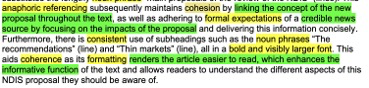
- Written discourse features - cohesion and coherence. While a bit boring, these are goodif you find yourself in a bit of a pickle time-wise. You can easily find examples to put in your AC to bulk it up. For example:
And that’s it! Ihope the importance of metalanguage is clearer and you understand how you canuse it to get maximum marks in your SACs and the final exam, for either Short Answer Questions, Analytical Commentaries and Essays.
Subscribe to our Newsletter
Learn more about our programs
Interested in more?
Take a read through our most recently published blogs.
.jpg)
.jpg)
.jpg)
.jpg)