


Hi everyone, my name is Poorva and I graduated from Mac.Rob in 2024, scoring a raw 46 in English Language 3/4. This blog will address one of the reasons that students are drawn to English Language over VCE Literature or VCE English - the style of writing. In order to score highly, do you still need to use fancy words in your SACs and Exams?
A student with average English results and a limited vocabulary hesitates before choosing VCE English Language because they assume that if their English is not strong, they will not be able to score well. In reality, however, the logic behind high scores in this subject is very different from what they imagine.
VCE English Language does not only test your English proficiency; it tests your ability to analyse language. Those two things are not the same.
This is also why many students seeking vce english language tutoring are often surprised to realise that analytical thinking matters far more than sounding “smart” on paper.
What is the real language you need to master?
In EL, a completely NEW concept is introduced - called metalanguage. No other English subject tests this, and it shifts the focus from whether your expression sounds beautiful to the content of your linguistic analysis.
Examples of metalanguage you would have seen throughout Units 1/2 (or will see - if you are a Year 10 student going into VCE)
· Polysyllabic noun
· Declarative sentence
· Cohesion and coherence
· Conative function
Sure, these words look new and different, but they’re simply the necessary tools for analysing language phenomena precisely.
The key thing to note here is that a whole heap of this content (yes, content, not writing devices) can be learnt systematically across your two years studying VCE English Language. This is akin to learning a science or math subject, where each unit you study unlocks a different part of the course that you will use to answer questions on the final exam.
This is what EL is called the science of the VCE Englishes!
Here is an excerpt of a SAC I wrote in Year 12, with very rudimentary writing, that scored the same as someone who wrote extremely eloquently, simply because we discussed the same ideas.
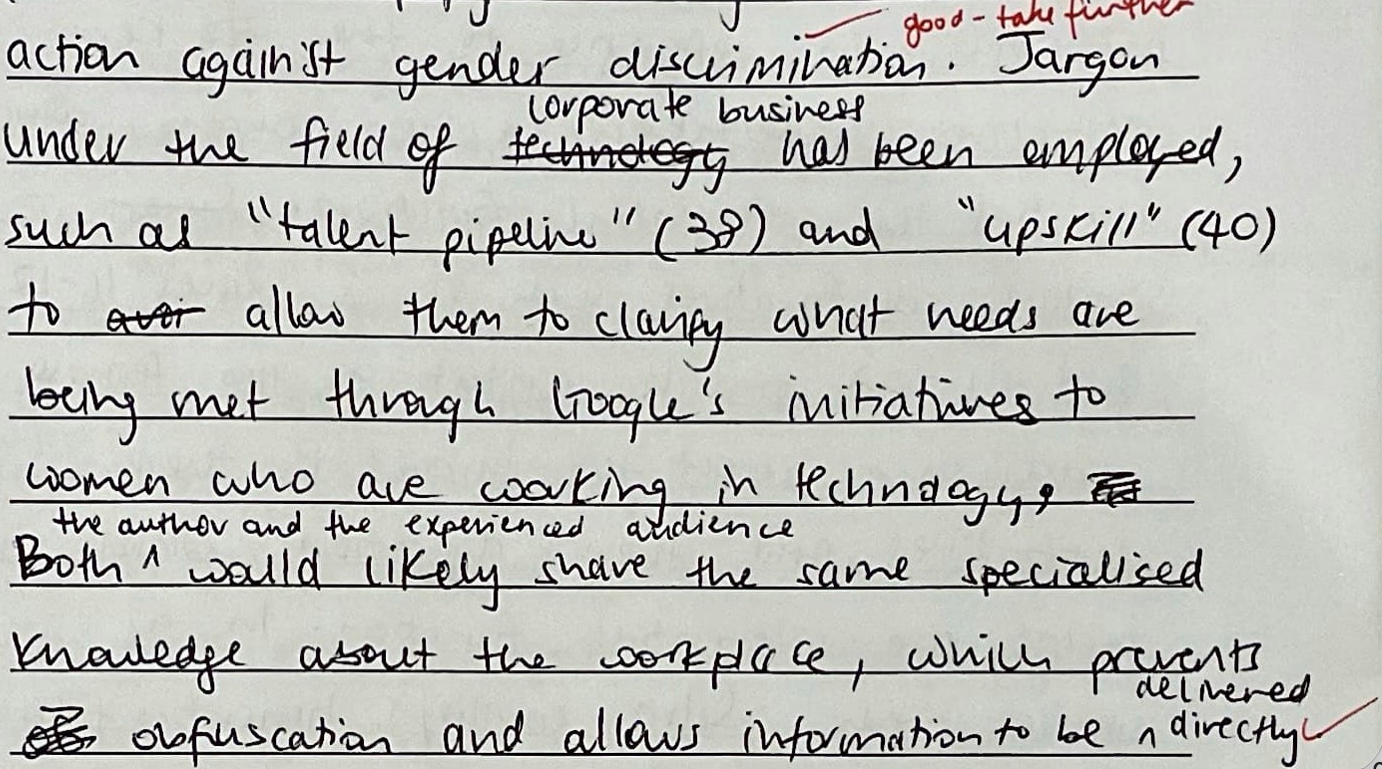
See how I used a lot of metalanguage and now too much flowery vocabulary
· Jargon, field, clarify, audience, obfuscation
This is something that my teachers and tutors helped me realise - not getting hung up on the fact that I couldn’t write as beautifully as some of my peers, but that I knew the content well and was able to discern different linguistic techniques with accurate metalanguage.
A good vce english language tutor will usually focus less on forcing students to memorise sophisticated vocabulary, and more on building a clear analytical structure that can consistently score well under exam conditions.
What does the VCAA Study Design say?
One common habit among high-scoring students is that they are familiar with the Study Design and use it to guide their preparation. This is relevant to any and all VCE subjects, not just English Language.
My tip: When I was creating my google docs notes for all of my VCE subjects, I separated it by each Area of Study for each Unit, and then copy pasted the Key Knowledge Points and Key Skills from that section of the Study Design into my notes. Having them handy and being able to reference them every time I opened my notes helped me keep track of my learning and that I was doing everything I needed to. See below a screenshot of my notes for VCE English Language 3/4:

What separates a Raw 35 student from a Raw 45 Study Score Student?
Ultimately, I think my answer to the above question boils down to this very simple expression: stop doing too much.
Instead of listing every feature you see → identify the most salient language features in the text
Instead of trying to make links across a whole bunch of things → follow "feature -> function -> context" logic to build clear Analytical Commentary paragraphs
Instead of going above and beyond to write a whole page for a 4 mark Short Answer Section A question → answer them within the line limit and focus on the function word
These abilities are not closely tied to native-level English proficiency, but they are highly connected to practice method and feedback quality.
This is why targeted feedback from an experienced english language tutor can often make a bigger difference than simply completing more practice questions without direction.
What kind of student are you?
Which of these three buckets do you think you best belong to?
Type A: Strong English background but limited analytical training: Your writing is fluent, but your Analytical Commentary often stays at a descriptive level. Your context analysis is weak, and you tend to lose marks in Section B.
Type B: Average English but strong logical thinking: Metalanguage feels unfamiliar to you at first, but once you build an analytical framework, you often improve very quickly. Your SAQ responses and essays can become especially stable.
Type C: Students who need to strengthen both areas: You need a systematic learning pathway more than blind question practice.
Well the good news is that this subject is incredibly coachable. Your starting point does not determine your final result.
VCE English Language is not a subject only for students who are already "good at English". It is a subject where any student willing to learn analytical frameworks systematically can work towards a high score.
For students currently considering vce english language tutoring, the most important thing is finding a learning approach that helps you understand why language choices work, rather than memorising complicated expressions that rarely improve your analysis.
If you want to find out whether your current study approach is actually moving you toward a Raw 40+, our team at Excel Education offers a free consultation where we will look at your writing and give you an honest assessment. Book a session with an english language tutor Melbourne - no fluff, just a clear picture of where you are and what to work on next.
Subscribe to our Newsletter
Learn more about our programs
Interested in more?
Take a read through our most recently published blogs.
.jpg)
.jpg)
.jpg)
.jpg)